
Chinese President Xi Jinping has underlined the need for building a combat-ready army and accelerate the building of the theatre joint combat command system, amidst the People's Liberation Army flexing its muscles in the disputed South China Sea.

The US is the worst-hit nation with 211,793 deaths and 7,549,429 infections.
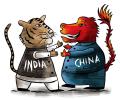
India and China achieved a major milestone this year when their bilateral trade crossed the landmark figure of $100 billion but it did not generate any fanfare in both capitals as the two Asian giants are going through a "particularly bad patch" in their relations due to a set of actions by Beijing in violation of agreements that led to the military standoff in eastern Ladakh. Starting with a modest $1.83 billion in 2001, the bilateral trade crossed $100 billion-mark in the first 11 months this year, a significant milestone for which the two countries carried out campaigns to boost trade and build it as a major stakeholder to improve the relations between two nations, whose ties otherwise remained frosty over the festering boundary dispute and strategic rivalry. According to last month's data from China's General Administration of Customs (GAC), the India-China bilateral trade totalled $114.263 billion, up 46.4 per cent year-on-year from January to November 2021.

Support from the committee gives Xi an indefinite extension on the reins of power, which will surely result in hawkish and insular policies. It does not bode well for relations with the USA, or with anyone else who does not bow the knee to Beijing, for that matter.

The chaos on its stock markets, a fierce battle between the old and new guard in the Communist Party and the restive border provinces of Tibet and Xinjiang forebode tough times ahead for China, says Claude Arpi.
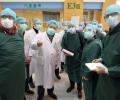
The death toll climbed to 2,592 with 150 new fatalities while the total number of confirmed cases increased to over 77,000, health officials said on Monday.

By the year 2027, which marks the centennial of the founding of the People's Liberation Army, China will build a fully modern military, a goal that is in alignment with the national strength and will fulfil the future national defence need, state-run Global Times quoted Chinese analysts as saying.

'Xi's assumption of absolute power is neither complete, nor irreversible.' 'Nor is it safe, for Xi, for his party, or for his country more generally.' 'And the government knows this,' says Mihir S Sharma.
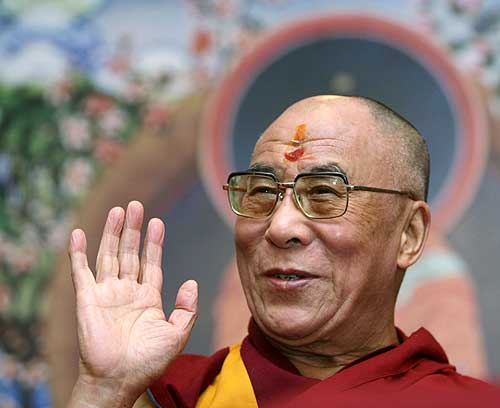
'The first time that China alleged the Dalai Lama was 'anti-national' and 'unpatriotic' was after he affirmed that Arunachal Pradesh and Tawang are part of India,' points out former RA&W official Jayadeva Ranade.

Will China's new military reforms endanger Xi Jinping's rule?

'India need to look beyond the economic prism.' 'China had no qualms in taking the Kashmir issue to the UN Security Council last year -- not once, but thrice -- thus violating Indian sensitivities,' observes China expert Srikanth Kondapalli.
After the Ladakh fiasco where Xi Jinping did not expect the Indian Army to resist his land-grabbing tactics, he has to save face before his colleagues in the Communist party.' To bring the threat of a mega-dam to the northern Indian border is a clever move, observes Claude Arpi.

'The mood in Beijing is already nervous and feverously watchful.' 'Developments in China will be scrutinised as intensely and nervously as the ones in Washington,' says Claude Smadja.
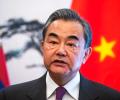
Was Wang Yi'S visit intended to remind India of 1962, asks Claude Arpi?

The seventh Tibet Work Forum was held in Beijing on August 28 and 29. Delhi should be deeply concerned, at a time India faces a precarious situation in Ladakh, because the TWF also defines China's western border policies, observes Claude Arpi.

As India rises, creating niche areas for itself in the Asian landscape, China and India are bound to step on each other's vital areas of importance, says Srikanth Kondapalli.

'Islamic State has declared that the liberation of Islamic Xinjiang from China is an objective. Beijing may well find that Pakistan is unable to assist in any meaningful way,' says China expert Jayadeva Ranade.

'Intrusions by PLA troops in the Ladakh sector are more in number than elsewhere and this region is now likely to remain an area of enhanced Chinese interest,' warns China expert Jayadeva Ranade.

Chinese Parliament approved the nomination of Vice President Xi Jinping for the vice-chairmanship of the powerful Central Military Commission, paving the way for him to succeed President Hu Jintao in 2012.
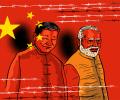
'An opportunity is at hand to think big and recast the India-China relationship on a new template, which would help the pursuit of our country's dream of major power status,' says Ambassador M K Bhadrakumar.

The talks took place in a beach resort in Benaulim on the sidelines of a meeting of the Council of Foreign Ministers of the Shanghai Cooperation Organisation.

Chinese President Xi Jinping on Sunday said the People's Liberation Army has the confidence and capability to defeat all invading enemies as he inspected a massive military parade at the country's largest military base to mark the 90th founding anniversary of the 2.3-million strong army.

To rise quickly in the PLA's hierarchy, you need to be close to Xi Jinping. Retired RA&W officer Jayadeva Ranade on the changes in China's military leadership.

'Tibetans will participate in future conflicts with India (in all probability, some were already present in Galwan).' 'As nobody in India would like to have a deadly fight with Tibetan soldiers and officers, the issue needs to be closely followed,' observes Claude Arpi.
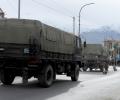
China is in no hurry to disengage at the border and the region and international community is moving on. The spectre of a long haul in Ladakh haunts India, points out Ambassador M K Bhadrakumar.

'The choice of Dhoka La for the intrusion by Chinese troops is significant and suggests a twin objective of pressuring Thimpu to allow Beijing to establish an embassy there and reinforcing Chinese claims on Arunachal Pradesh,' warns former RA&W officer Jayadev Ranade.

'Does it mean that we are witnessing the end of an era?' 'Probably not, but the post-Trump trade war has certainly brought a lot of instability in China,' notes Claude Arpi.

Recent IMF forecast said China's growth is expected to slow down.

'That the two sides allowed such a situation to arise exposed the level of inaction and inefficiency in China-India border management.' 'The Modi-Xi meeting in Xiamen initiated a process to to avert such contingencies in the future.'
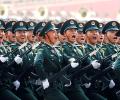
Currently, the reserve forces are under the dual leadership of military organs and local Communist Party committees and they would be brought under the control of the ruling party and the CMC from July 1, the state-run Xinhua news agency reported.

India and China on Tuesday agreed to "jointly deal with security threats" and take measures to strengthen cooperation in combating terrorism during their first dialogue on counter-terrorism and security in Beijing, amid Indo-Pak tensions following the Uri terror attack.
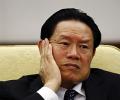
Zhou Yongkang, one of China's top leaders in the previous Hu Jintao's regime, has been charged with trading power for sex, adultery and leaking state secrets.

Important for India was Xi's meeting with representatives of PLA officers and soldiers stationed in Tibet. The video of the encounter was interesting to watch, especially the large number of lieutenant generals and major generals, observes Claude Arpi.

India and China on Friday agreed to set up a dedicated communication channel to boost security cooperation as Home Minister Rajnath Singh held talks with China's security czar on issues like cross border terrorism from Pakistan and the Afghan situation.
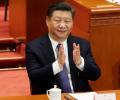
Xi, the most powerful leader in recent decades heading the ruling Communist Party and the military, will now be the first Chinese leader after the founder chairman Mao Zedong to remain in power lifelong.
Being a pragmatist Modi is not likely to give preference to China over Japan. Both security and economic aspects are likely to shape Modi's decision in terms of engaging the two biggest economies of Asia, says Sana Hashmi.

The death toll in the tragedy in the mighty Yangtze rose to 65 as rescuers retrieved another 39 bodies till morning.

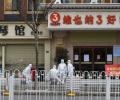
The Wuhan local administration earlier announced that people who are not quarantined and seeking special treatment or stranded in the city can leave in batches.

Why is China's supreme leader promoting Han Chauvinism so aggressively, asks Claude Arpi.
 © 2026 Rediff.com - Advertise with us - Disclaimer - Privacy Policy - Sitemap - Feedback - About us - Terms of use - Grievances